
YouTube's own help page puts it simply: to get a dubbed audio track, "you can either outsource your dubbing needs to a vendor or record yourself speaking in another language" (YouTube Help). This page is about the first option. We run Human Voice Over (HVO), a New York dubbing studio where real voice actors, not AI, dub YouTube videos, so this is how a human dubbing service works from the inside, and what to check before you hire one, us included.
What a dubbing service does for you
Dubbing is more than translating a script and reading it out. Each language goes through the same steps, and a service should handle every one of them:
| Step | The dubbing service | You |
|---|---|---|
| Send the video | — | Send the finished video. No special files needed. |
| Script | A native translator adapts the script, then a second person checks it. | Nothing, unless you want to flag names or phrases. |
| Casting | The service runs auditions for each speaker. | Pick the voice actors you like. |
| Recording | Voice actors record in a studio; every recording is checked. | Nothing. |
| Mix | Engineers mix the voices with your music, sound effects and the original atmosphere. | Nothing. |
| Final check | Native speakers check every language. | Nothing. |
| Delivery | Each language comes back ready for YouTube's multi-language audio. | Add the track to the video in YouTube Studio, or have your team do it. |
Steps: HVO's own process. YouTube steps: YouTube Help, "Add Multi-language features to your videos", checked 9 November 2026.
The point of hiring a service is that the middle of that table stops being your problem. The casting step is the one part we always hand back to the creator: you hear the auditions and choose the voices your viewers will hear every week.
What you get back for each language
At HVO, every language comes back with:
- The mixed dub, ready to upload as an audio track: the new voices with your music, sound effects and atmosphere underneath.
- The raw voice recording, without the mix, in case your editor wants to change something.
- Subtitles in that language.
- Translated title and description, so viewers searching in that language can find the video. YouTube says its search looks at translated titles and descriptions.
- Translated thumbnail text, if you want a thumbnail in that language.
If a service only sends back one audio file, you'll end up translating the title, description and thumbnail yourself, and those are what decide whether a viewer in another country clicks at all. Here's how the thumbnail part works on YouTube: How to add localized thumbnails to dubbed YouTube videos.
How the tracks get onto YouTube
A dubbed track doesn't need its own channel. With YouTube's multi-language audio, every language sits on the same video, and viewers hear their own language by default, picked from their watch history. They can switch tracks in the player settings.
To add a track, your channel needs access to YouTube's advanced features. Then, in YouTube Studio on a computer:
- Open Languages and click the video.
- Click Add Language and choose the language.
- Next to Dub, click Add and upload the audio file. It has to be audio-only and roughly the same length as the video.
- Click Publish.
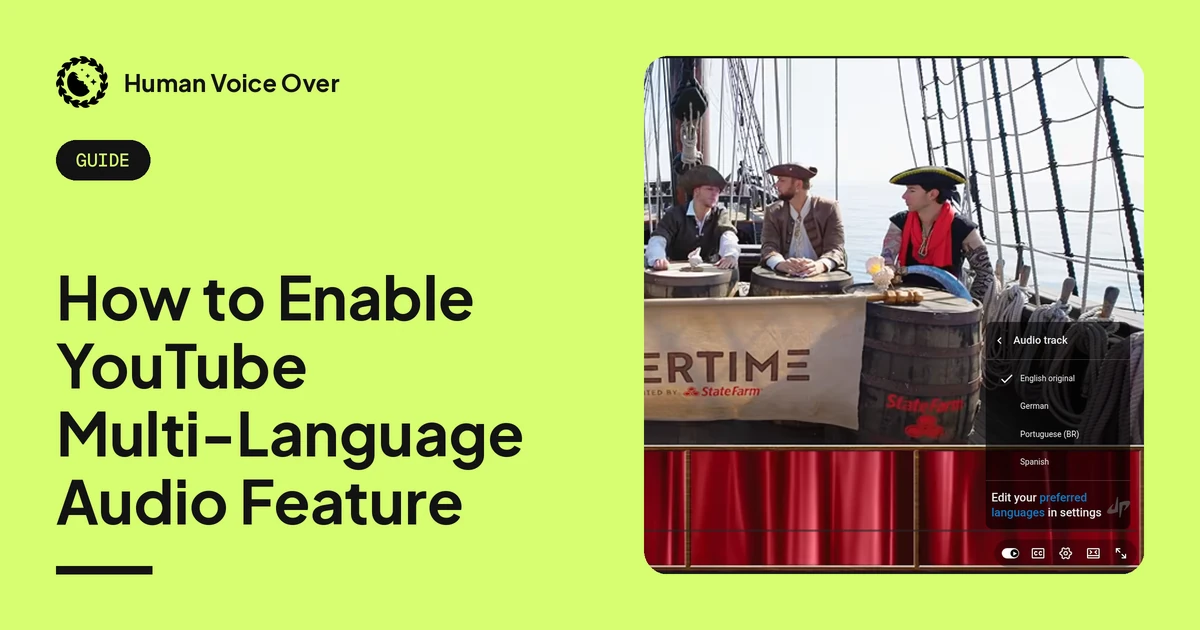
If YouTube has already made an automatic dub in that language, you have to delete it before you can upload your own. Step-by-step guides: How to enable YouTube's multi-language audio feature and Replace YouTube auto-dub with a custom human track.
How long it takes
At HVO, usually 7–10 days from the moment we receive the video to delivery, for a regular long video. In our records from July to October 2026, the typical (median) time was about 10 days. Most of that time is the work in the table above: translation and its second check, recording, the mix and the native-speaker check. A rushed dub usually skips one of the checks.
If you post on a schedule, the practical answer is to send each video as soon as the edit is locked, and to release the dubbed tracks a few days after the original if you need to.
Human dubbing service or AI dubbing tool?
Some services sold as dubbing are AI tools: they generate a synthetic voice from a translated script. YouTube also has its own automatic dubbing, switched on by default for eligible channels. YouTube's help page says those dubs "might contain errors due to mispronunciations, accents, dialects, or background noise", can struggle with "proper nouns, idioms, and jargon", and "you cannot edit automatic dubs" (YouTube Help, checked 9 November 2026).
An AI tool is often fine for tutorials, quick updates and large back catalogues. A human service is worth it when the creator's personality is the product: the same people every week, jokes, timing, several people talking, sponsor reads. We compare the two honestly, with a free side-by-side you can listen to, in Human vs AI Dubbing for YouTube: Which Is Better?.
What to check before you hire one
Five questions sort out most services quickly. Put them to any service before you send a video:
- Who performs the voices? Real voice actors, or a synthetic voice?
- Will the same voice come back? Viewers get used to a voice. Ask whether the same actor returns for every recurring speaker, video after video.
- Who checks the translation? One translator working alone misses things. Ask whether a second person checks the script and whether native speakers check the final audio.
- What exactly comes back? Mixed audio only, or also the raw recording, subtitles, and translated titles, descriptions and thumbnail text?
- How long does a regular video take? Get a typical number for a normal long video, not a best case.
Our answers: real voice actors, the creator picks them from auditions, the same actor returns for every recurring speaker, a second person checks every script and native speakers check every language, the full list above comes back, and it usually takes 7–10 days. More on choosing: How Do You Choose the Right YouTube Dubbing Service?
Who uses a human dubbing service
Since mid-2025, HVO has dubbed 1,000+ videos and 100,000+ minutes of finished audio for 30+ creator channels, with 750+ voice actors and 600+ translators in about 60 locations. Our dubs have passed 1 billion views. Creators like Dude Perfect, Preston and Nick DiGiovanni dub with HVO, and you can see who else, and which languages they started with, on Creators Who Dub With HVO.
To see what dubbing your videos would cost, the dubbing calculator gives a starting price. Or book a call and we'll go through which videos and languages make sense for your channel.
Questions creators ask
What does a YouTube dubbing service do?
It turns your finished video into audio tracks in other languages. A human service translates and adapts the script, casts and records voice actors, mixes the voices with your music and effects, checks every language with native speakers, and delivers tracks you add to the same video in YouTube Studio.
What do I need to send a dubbing service?
At HVO, just the video. No special files are needed. You also pick the voice actors from auditions.
How long does human dubbing take?
At HVO, usually 7–10 days from submission to delivery for a regular long video.
Do I need a separate channel for each language?
No. With YouTube's multi-language audio, every language is an audio track on the same video, and viewers hear their own language by default. Your channel needs access to YouTube's advanced features.
How many languages can a video be dubbed into?
HVO dubs into 45+ languages. The most requested in our records since mid-2025 include Spanish (Latin America), Brazilian Portuguese, French, Russian, Arabic, Indonesian, Hindi, Vietnamese, German and Japanese.
How much does a YouTube dubbing service cost?
It depends on how many minutes you dub and into how many languages, and human dubbing costs more than an AI tool because a translator, a reviewer, voice actors, a studio, an engineer and a native-speaker check go into every language. The dubbing calculator gives a starting price for your videos.