
Most creators who ask whether dubbing increases views already have a sense that it might. What they want to know is how much, for whom, and why some channels add dubs and see almost nothing change.
We run Human Voice Over (HVO), a New York dubbing studio where real voice actors, not AI, dub YouTube videos into 45+ languages. So we have a stake in the answer. That's why this page leans on what YouTube itself has published, checked on 16 November 2026, and keeps our own view clearly marked as ours.
What YouTube's own numbers say
YouTube has published a handful of figures on dubbed audio. They're the closest thing to hard data there is:
| Question | What YouTube published | When |
|---|---|---|
| Watch time | On average, creators uploading multi-language audio tracks saw over 25% of their watch time come from views in the video's non-primary language. | Figure as of July 2025, published 10 Sep 2025 |
| One channel | On chef Jamie Oliver's channel, multi-language audio tracks "amplified views by 3x". His team first looked at where viewers were watching from, then started with Spanish and Portuguese. | 10 Sep 2025; 30 Jul 2024 |
| A TV library | Fremantle (Got Talent, The X Factor) reached almost 6 million plays on its dubbed tracks. | 30 Jul 2024 |
| Auto dubs | In December 2025, more than 6 million viewers a day watched at least 10 minutes of auto-dubbed content. | 4 Feb 2026 |
Sources: YouTube Blog, "Unlock a world of viewers with multi-language audio" (10 Sep 2025), "How multi-language audio expanded 3 YouTube channels' reach" (30 Jul 2024) and "Unlocking a global audience with auto dubbing" (4 Feb 2026); YouTube Help, "Add Multi-language features to your videos". All checked 16 November 2026.
Two things are worth reading into that first number. If a quarter of a video's watch time comes from dubbed tracks, the original language carries the other three quarters, so the dubs add roughly a third on top of what the original earns alone. That's our arithmetic, and it assumes most of those viewers would not have watched in the original language, which is the point of dubbing. And it is an average across the creators who chose to dub, many of them big channels that already had viewers abroad. It's a fair benchmark, not a promise.
Why a dub adds views instead of splitting them
The reason dubbing can add views at all is how YouTube handles it. A dubbed track isn't a second video. It is an extra audio track on the same video, on your main channel, so every view in every language lands on that one video (YouTube Help).
Three things follow from that:
- Nobody loses the original. The audio defaults to each viewer's preferred language, worked out from their watch history, and anyone can switch tracks in the player.
- The video can be found in the new language. Once the title and description are translated, YouTube's search reads them, so a viewer searching in Spanish can find a video you made in English.
- Older videos get a second run. You can add a track to a video you published years ago. Views on that track are views the video wasn't getting before.
Our complete guide to multi-language audio covers the setup itself: what your channel needs, the upload steps, and what to do when the option is missing.
When dubbing doesn't move your views
When a creator adds dubs and nothing changes, it's usually one of these. The causes are our reading; the fixes match what YouTube's help pages say:
| What happened | Why views stay flat | What to change |
|---|---|---|
| Five or six videos dubbed, then a pause | New viewers find one dubbed video and have nothing else to watch in their language. | YouTube's advice: go deep in one or two languages and dub half or more of your back catalog if you can. |
| The title and description are still only in English | The video can't show up when people search in their own language. | Translate the title and description for each dubbed language. Long videos can also get a thumbnail per language. |
| The language was a guess | Few of your viewers, or of the people searching your topic, speak it. | Start where your audience already is: Analytics shows which countries watch you, and regular comments in another language are a good sign. |
| The dub sounds flat or gets names wrong | The views come, but viewers leave in the first minute. | Listen to the opening, the jokes and the sponsor read in that language. A voice that doesn't match the creator is what viewers notice first. |
| Nobody knows the dub exists | Fans who already watch you with subtitles, or in English, never open the audio menu. | Tell viewers the video is dubbed, as YouTube suggests, for example in the video itself or a pinned comment. |
YouTube's advice in the right column: YouTube Help, "Add Multi-language features to your videos" (best practices, translated titles, thumbnails per language). Checked 16 November 2026. The first two columns are HVO's experience.
Translated thumbnails are covered in How to Add Localized Thumbnails to Dubbed YouTube Videos. For which language to pick first, see the best languages to dub YouTube videos into. For reference, the languages creators have asked HVO for most since mid-2025 start with Spanish (Latin America), Brazilian Portuguese, French, Russian, Arabic, Indonesian and Hindi.
How to measure the lift on your own channel
You don't have to take YouTube's average on trust. Your own analytics show the extra views directly, because each dubbed track is counted separately:
- In YouTube Studio, open Analytics, choose Advanced mode and break the report down by audio track. (Step by step, with how to read each track: Does YouTube Auto Dubbing Hurt Your Views?)
- Add up the watch time on all your dubbed tracks and divide it by the video's total. That's your share. YouTube's average for creators with their own dubs is over 25%.
- For older videos you dubbed, compare the 28 days before the track went up with the 28 days after. The dubbed track's views are the new part; the original track tells you whether anything else changed.
- Judge a language on a run of videos over a few weeks, not on one upload. A single dubbed video can swing either way.
If a language gets views but people leave much earlier than on the original, the demand is there and the dub is the problem. If it gets almost no views after a dozen dubbed videos with translated titles, the demand probably isn't, and that language can wait.
Human or auto dubs, if growth is the goal
YouTube's 25% figure is for creators who uploaded their own dubbed tracks. For its automatic dubs, YouTube has published an audience size, 6 million daily viewers, and said they don't hurt the original video's discovery, but no matching share of watch time. So the strongest published evidence for dubbing and views is about dubs creators made and uploaded themselves. Auto dubs cost nothing and may bring some viewers; the difference shows up in how long those viewers stay. You can hear both on the same video in Human vs AI Dubbing for YouTube.
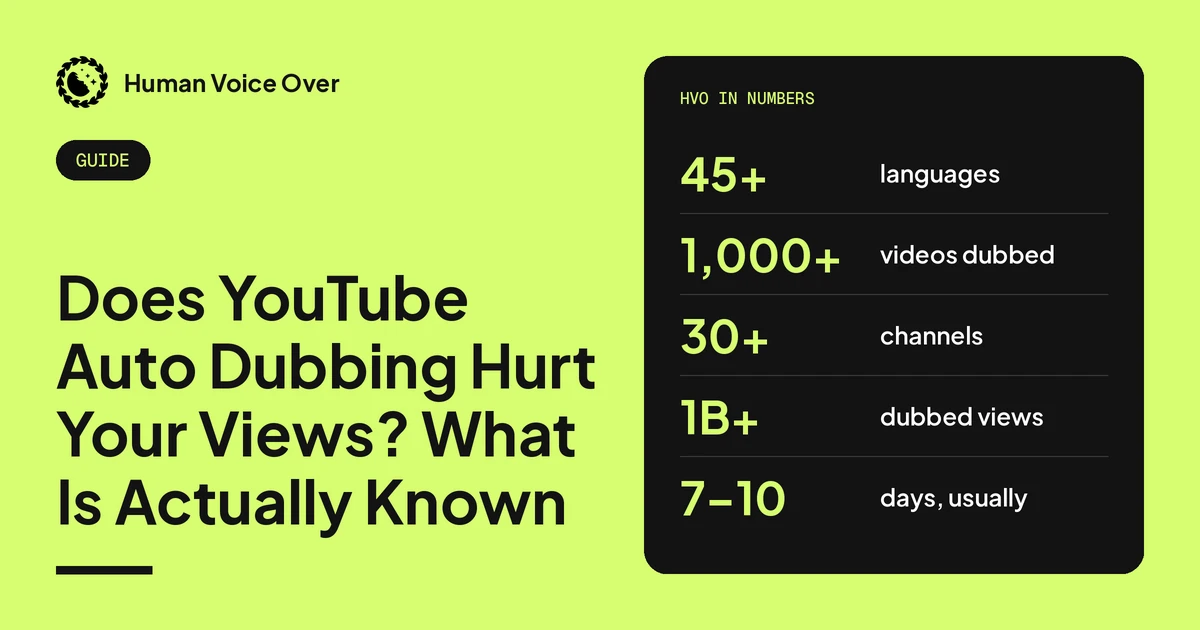
At HVO, a native translator adapts the script and a second person checks it, you pick the voice actors from auditions, and the same actor returns for every recurring speaker, so viewers in each language hear the same "you" every week. Engineers mix in your music and effects, native speakers check every language, and each track comes with translated titles, descriptions and thumbnail text. It usually takes 7–10 days for a regular long video. Since mid-2025 we've dubbed 1,000+ videos for 30+ creator channels, including Dude Perfect, Preston and Nick DiGiovanni, one of the creators YouTube featured when it opened multi-language audio to more channels in September 2025. Our dubbed tracks have passed 1 billion views. How the work runs: YouTube Dubbing Services: How Human Dubbing Works.
Want a number before you decide? The dubbing calculator gives an estimate for your videos, or book a call and we'll look at which language your numbers point to first.
Questions creators ask
Does dubbing increase YouTube views?
Usually, when you dub enough videos in a language your audience speaks. YouTube says creators who uploaded their own dubbed tracks got over 25% of their watch time from the non-primary languages, on average, and Jamie Oliver's channel saw views amplified 3x.
Do views on a dubbed track count toward the original video?
Yes. A dubbed track is an extra audio track on the same video, not a separate upload, so views in every language count toward that one video on your main channel.
How many videos should I dub before I see results?
YouTube recommends going deep in one or two languages and, if you can, dubbing half or more of your existing videos. Judge a language on a run of videos over a few weeks, not on a single upload.
Can dubbing old videos bring new views?
Yes. You can add a dubbed track to a video you published long ago. Any views on that track are views the video wasn't getting in the original language.
Why didn't my views go up after dubbing?
The usual causes are too few videos dubbed, titles and descriptions left untranslated, a language few of your viewers speak, or a dub that doesn't hold viewers past the first minute. Check watch time by audio track to see which one it is.
Are human dubs better than auto dubs for growing views?
YouTube's published watch-time figure comes from creators who uploaded their own dubbed tracks. For auto dubs it has published audience size but no matching figure, so compare how long viewers stay on each track in your own analytics.